


Customize
About Item
Comprehensive energy audit of HVAC and refrigeration systems including chillers, cooling towers, air handling units, compressors, cold storage systems, and temperature control mechanisms to improve efficiency and reduce operating costs.
Service Overview
HVAC and refrigeration systems are among the largest energy consumers in industrial facilities, commercial buildings, cold storage units, and agri-processing plants. Inefficient cooling systems can lead to excessive electricity usage, inconsistent temperature control, product spoilage, and high maintenance costs.
Our HVAC & Refrigeration Energy Audit provides a structured technical evaluation of cooling and air-conditioning infrastructure to identify inefficiencies, optimize performance, and reduce energy consumption without compromising environmental control.
The service focuses on improving system reliability, reducing load stress, and enhancing operational sustainability.
Chiller & Cooling System Performance Analysis
Cooling equipment must operate at optimal efficiency.
The audit includes:
Chiller performance testing
Coefficient of performance (COP) evaluation
Cooling load assessment
Compressor efficiency analysis
Cooling tower performance review
Heat exchanger inspection
Refrigerant level verification
This ensures efficient cooling output per unit of energy consumed.
Air Handling & Ventilation Assessment
Proper airflow management impacts both energy and comfort.
We evaluate:
Air handling unit (AHU) efficiency
Duct leakage detection
Airflow balancing
Filter condition inspection
Fan performance analysis
Ventilation scheduling optimization
This improves indoor environmental quality while reducing energy waste.
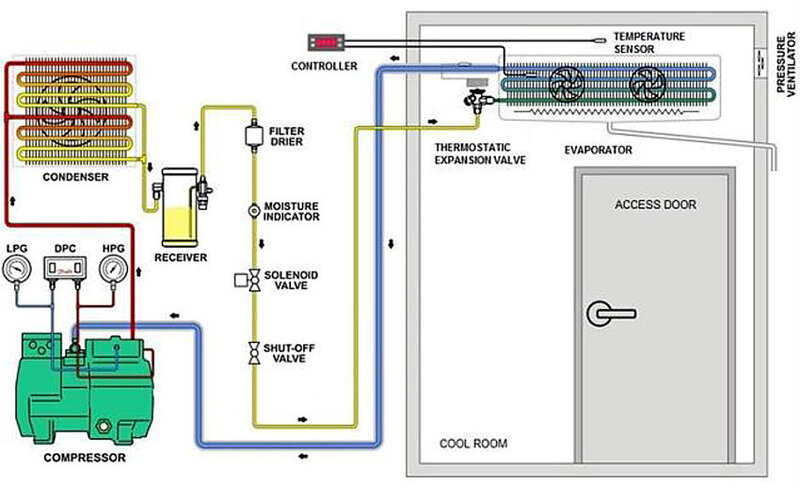
Cold Storage & Refrigeration Efficiency Review
Temperature-controlled storage requires precise operation.
The service assesses:
Refrigeration compressor performance
Evaporator and condenser efficiency
Insulation integrity of storage rooms
Door sealing condition
Temperature fluctuation monitoring
Defrost cycle optimization
This reduces spoilage risk and lowers energy demand.
Load Optimization & System Controls
Automation enhances HVAC efficiency.
We review:
Thermostat calibration
Sensor accuracy
Automation control systems
Time-based scheduling
Peak load management
Integration with building management systems
This supports dynamic energy control.
Insulation & Thermal Loss Assessment
Thermal inefficiencies increase cooling demand.
The audit includes:
Pipe insulation inspection
Wall and roof thermal integrity
Heat gain evaluation
Solar load assessment
Sealing and leakage detection
This reduces unnecessary cooling loads.
Energy Savings & ROI Evaluation
All findings are supported with financial analysis including:
Estimated electricity savings
Maintenance cost reduction
Capital upgrade estimation
Payback period analysis
Long-term lifecycle savings
This ensures practical and financially viable recommendations.
Target Participants
Industrial facility managers
Cold storage operators
Warehouse supervisors
Commercial building managers
HVAC maintenance teams
Energy managers
Agri-processing facility operators
Business & Operational Benefits
Reduced electricity consumption
Improved cooling efficiency
Lower maintenance costs
Extended equipment lifespan
Improved temperature stability
Reduced carbon footprint
Better regulatory compliance
Enhanced product preservation