


Customize
About Item
Decentralized Wastewater Treatment Systems (DEWATS) for Rural Clusters provide low-energy, community-scale wastewater treatment solutions for villages, agro-processing clusters, and rural institutions, enabling safe discharge and water reuse without complex infrastructure.
Overview
Rural clusters, agro-processing hubs, dairy cooperatives, and agricultural institutions often lack access to centralized sewage networks. Discharging untreated wastewater can contaminate soil, groundwater, and nearby water bodies.
Decentralized Wastewater Treatment Systems (DEWATS) offer sustainable, low-maintenance treatment solutions designed for rural environments. These systems rely on gravity-based flow, biological processes, and natural treatment methods to treat domestic and agro-industrial wastewater effectively.
DEWATS systems are cost-effective, scalable, and ideal for rural and semi-urban agri ecosystems.
Wastewater Assessment & Cluster Planning
Every cluster has unique wastewater characteristics.
Assessment includes:
Daily wastewater volume estimation
Organic load analysis (BOD/COD)
Domestic vs agro-process wastewater segregation
Land availability assessment
Topographical survey
Compliance requirement evaluation
Proper planning ensures effective system sizing.
Modular Treatment Components
DEWATS integrates simple yet efficient stages.
Core components include:
Settler or sedimentation tanks
Anaerobic baffled reactors (ABR)
Anaerobic filters
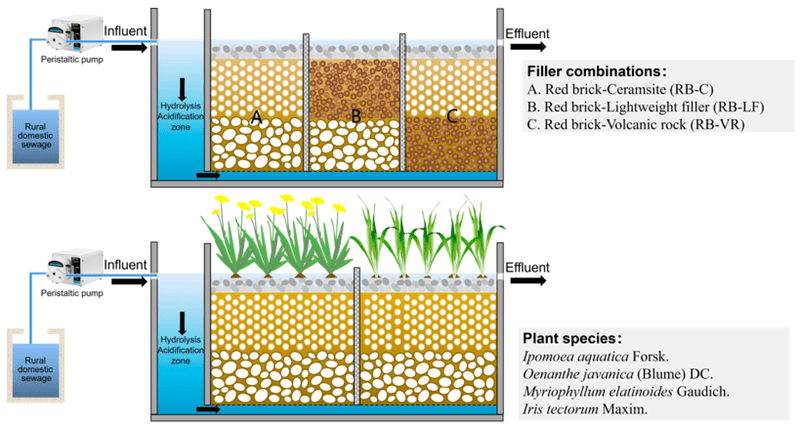
Planted gravel filters
Constructed wetlands
Polishing ponds
Natural biological processes reduce pollutant load.
Low-Energy & Gravity-Based Operation
DEWATS minimizes operational complexity.
System features include:
Minimal electricity requirement
Low maintenance needs
Passive biological treatment
Durable civil structures
Community-friendly design
Long operational lifespan
Reduced mechanical dependence lowers costs.
Water Reuse & Environmental Integration
Treated water can be reused locally.
Reuse options include:
Irrigation of crops
Landscape watering
Groundwater recharge
Farm pond integration
Tree plantation support
Local reuse strengthens water security.
Sludge & Residual Management
Sedimentation generates sludge that requires periodic removal.
Management includes:
Scheduled desludging
Composting integration
Safe disposal planning
Nutrient recovery (where suitable)
Compliance documentation
Proper management prevents secondary pollution.
Community Training & Governance Support
Community ownership ensures sustainability.
Support includes:
Operational training for local operators
Maintenance planning
Compliance awareness programs
Monitoring documentation
Governance model advisory
Capacity building strengthens long-term viability.
Environmental & Social Benefits
DEWATS improves rural sanitation and sustainability.
Environmental benefits include:
Reduced groundwater contamination
Improved surface water quality
Lower ecological impact
Reduced nutrient discharge
Social benefits include:
Improved community hygiene
Reduced disease risk
Employment generation
Strengthened rural infrastructure
Strategic Importance in Rural Water Sustainability
Decentralized Wastewater Treatment Systems are ideal for rural agricultural ecosystems where centralized treatment is not feasible. They provide affordable, scalable, and environmentally responsible wastewater management solutions.
Strategic advantages include:
Cost-effective rural sanitation
Reduced environmental liability
Improved water reuse
Strengthened community resilience
Enhanced sustainability performance
Ideal Customers
Rural villages
Farmer Producer Organizations (FPOs)
Dairy cooperatives
Agro-processing clusters
Agricultural research stations
Rural educational campuses