


Customize
About Item
Biomass Supply Chain Management Service provides end-to-end coordination of crop residue sourcing, aggregation, storage, transportation, and delivery to biomass power plants, pellet units, and industrial users, ensuring consistent and reliable biomass supply.
Overview
Crop residues such as paddy straw, wheat straw, maize stalks, and cotton stalks are valuable biomass resources. However, without structured supply chain systems, biomass availability becomes inconsistent, leading to operational challenges for energy plants and industrial buyers.
Biomass Supply Chain Management Service creates a streamlined ecosystem that connects farmers, aggregators, transporters, storage hubs, and industrial consumers. The service ensures steady, quality-controlled, and cost-efficient biomass flow throughout the year.
This structured approach transforms agricultural waste into a sustainable industrial resource while preventing field burning.
Structured Sourcing & Farmer Network Development
Reliable biomass supply begins with farmer engagement.
Sourcing support includes:
Cluster-based farmer onboarding
Seasonal residue availability planning
Long-term supply agreements
Volume forecasting
Harvest-aligned collection scheduling
Incentive-based participation models
Organized sourcing stabilizes biomass flow.
Aggregation & Quality Standardization
Uniform quality is essential for industrial use.
Aggregation features include:
Centralized biomass collection centers
Moisture content testing
Bale density standardization
Batch tagging and tracking
Segregation by crop type
Quality documentation for buyers
Standardization improves buyer confidence.
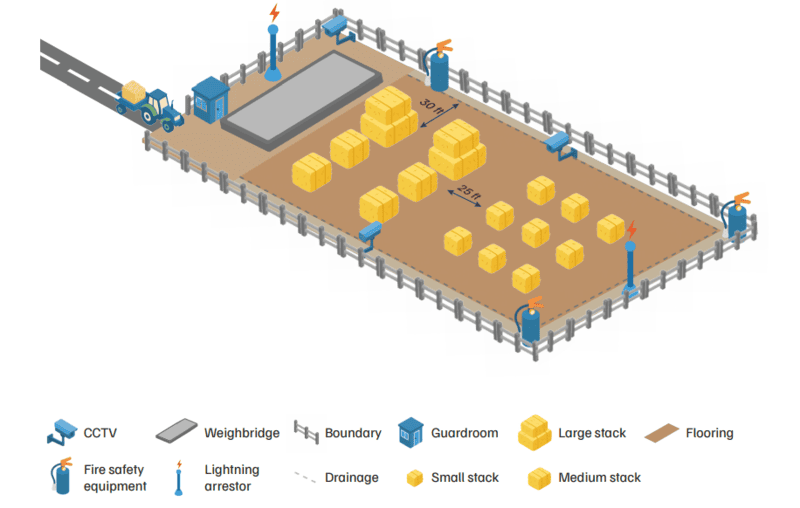
Storage & Buffer Stock Planning
Biomass is seasonal but industrial demand is continuous.
Storage capabilities include:
Temporary and permanent biomass warehouses
Covered storage facilities
Elevated stacking systems
Buffer stock management
Seasonal surplus handling
Fire safety compliance measures
Buffer stock planning ensures uninterrupted supply.
Transportation & Logistics Coordination
Efficient logistics maintain cost competitiveness.
Logistics management includes:
Farm-to-aggregation transport
Bulk dispatch to biomass plants
Route optimization planning
Fleet tracking systems
Load consolidation
Timely delivery scheduling
Integrated transport reduces operational delays.
Industrial Linkage & Demand Forecasting
Supply must align with industrial requirements.
Industrial coordination includes:
Biomass power plant contracts
Pellet and briquette manufacturer supply
Paper and pulp industry linkage
Continuous demand forecasting
Just-in-time delivery systems
Production cycle alignment
Alignment prevents supply shortages.
Environmental & Sustainability Compliance
Structured biomass supply supports climate goals.
Sustainability benefits include:
Reduced stubble burning
Lower air pollution
Carbon emission reduction
Renewable energy promotion
Circular economy development
Biomass management strengthens sustainability metrics.
Financial & Economic Advantages
Supply chain efficiency improves profitability.
Economic benefits include:
Stable revenue for farmers
Lower raw material costs for industries
Reduced logistics inefficiencies
Improved contract reliability
Scalable rural employment generation
Organized systems create long-term value.
Strategic Importance in Crop Residue Ecosystem
Biomass Supply Chain Management is the backbone of residue-based energy and industrial applications. By converting scattered agricultural waste into a structured commodity, it bridges the gap between farm-level supply and industrial demand.
Strategic advantages include:
Strengthened renewable energy supply chains
Increased rural income diversification
Reduced environmental pollution
Improved supply predictability
Enhanced sustainability performance
Ideal Customers
Biomass power plants
Pellet and briquette manufacturers
Industrial energy users
Farmer Producer Organizations (FPOs)
Agricultural cooperatives
Renewable energy companies